
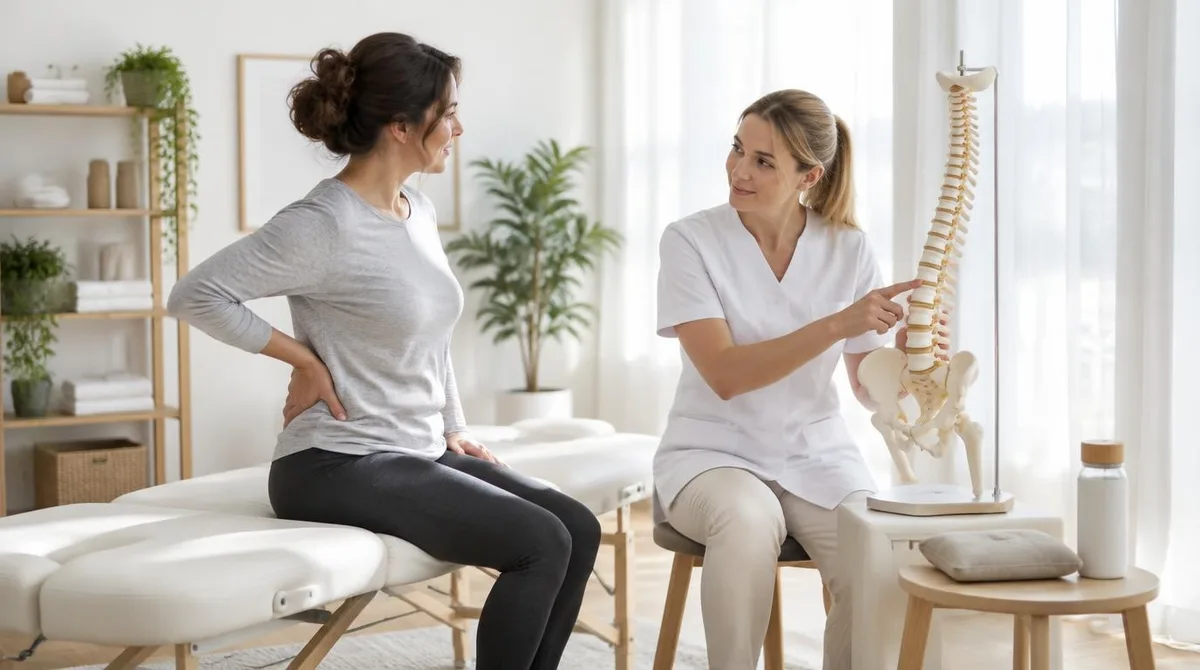
Female lower back pain has a wider list of possible causes than most people expect. Alongside the usual muscle strains and spine wear, conditions tied to the menstrual cycle, the ovaries and the urinary tract can send pain to the same spot. The right treatment depends entirely on which one is behind it.
The lower back and pelvis share joints, ligaments and nerves, and organs such as the kidneys and ovaries sit in the same region. That is why a gynecological problem can feel like a back problem, and vice versa. According to Healthline, common causes of pelvic and lower back pain occurring together include arthritis, kidney or urinary tract infections, endometriosis, kidney stones, muscle overuse and injury — and in females, ovarian cysts and premenstrual syndrome (PMS) may also contribute.
This guide walks through the causes clinicians consider first in women, what the treatment options look like, and the warning signs that mean the pain needs a doctor now rather than later. It is information, not medical advice; for any decision about your own symptoms, talk to your clinician.
Why do periods cause lower back pain?
Period pain, called dysmenorrhea, comes from an overproduction of prostaglandins — fats that act like hormones and make the uterus contract. For many people the cramping stays in the lower abdomen, but it can radiate to the lower back. Medical News Today reports that more than half of people who menstruate experience period pain, and that over-the-counter nonsteroidal anti-inflammatory drugs (NSAIDs), such as ibuprofen, can often help manage it.
Pain tied to the cycle usually arrives just before or during a period and settles as it ends. Pain that is severe enough to interfere with daily activities is not something to push through. Medical News Today advises speaking with a doctor in that case, and lists symptoms worth investigating: heavy bleeding, blood clots in the menstrual flow larger than a quarter, and pain or bleeding between periods.
Could it be endometriosis or an ovarian cyst?
Endometriosis happens when tissue similar to the lining of the uterus grows elsewhere in the body. It can cause chronic back or pelvic pain, painful urination or bowel movements, pain during or after sex, spotting between periods, digestive symptoms and difficulty getting pregnant. Around 11% of females aged 15 to 44 in the United States are affected, according to Medical News Today.
Treatment varies with symptom severity and whether a person wants to become pregnant. Options described in the source material include pain medication, hormonal birth control that reduces or stops periods for those not trying to conceive, gonadotropin-releasing hormone agonists for those who are, and surgery in severe cases to remove the tissue. Ovarian cysts, another gynecological cause, may also contribute to lower back and pelvic pain in females, so a clinician may examine or image the pelvis when the pattern suggests it. We covered a connected angle in Lower back pain stretches: a full routine with order and timing.
What about infections and kidney stones?
Urinary causes matter because they can look deceptively like ordinary backache. Kidney stones form when minerals such as calcium, oxalate and phosphorus build up in the kidneys. They can cause sharp pain in the back, side, lower abdomen or groin, often coming in waves, sometimes with nausea, vomiting, or fever and chills. Some stones pass on their own; a doctor may recommend plenty of water and OTC NSAIDs for pain, while others need a procedure to break the stones up.
A kidney infection is more urgent. It usually starts when bowel bacteria enter the urinary tract and travel up to the kidneys, and it can bring fever, chills, cloudy or foul-smelling urine, blood in the urine, and painful, frequent urination alongside lower back or groin pain. Medical News Today describes it as a serious condition needing immediate treatment, usually with antibiotics, to prevent complications such as sepsis. One caution worth knowing: people aged 65 and over may show confusion or unclear speech instead of these typical symptoms.
What if it is the spine itself?
Much lower back pain is mechanical — a muscle strain, disc degeneration, facet joint arthritis, spinal stenosis or sacroiliac joint dysfunction. Chronic low back pain, defined as pain persisting more than 12 weeks, affects approximately 8.2% of American adults according to a U.S. National Health Interview Survey cited in the Nevada Appeal, which also notes that the World Health Organization ranks low back pain as the single leading cause of disability worldwide.
The evidence supports staying active rather than resting. Physical therapy is described as a first-line intervention, focused on flexibility, core strength and posture, with heat, massage and spinal manipulation offering symptomatic relief. NSAIDs have some evidence for efficacy; muscle relaxants, antidepressants and anticonvulsants may be considered in certain cases, while opioids are generally avoided for long-term use because of limited benefit and serious risks. Cognitive-behavioral therapy can help when pain is shaped by stress or fear of movement, and procedures such as epidural steroid injections are typically reserved for cases where conservative measures fail.
For gentle movement at home, our step-by-step routines at stretches for lower back pain: five moves, step by step and lower back pain stretches: a full routine with order and timing show how to sequence them safely.
What actually helps — and when to talk to a clinician
Our analysis of the evidence points to one clear theme: treatment follows the cause. The source material lists options that may bring relief for combined pelvic and lower back pain — OTC or prescription pain or anti-inflammatory medication, physical therapy including pelvic floor work, hot and cold therapy, massage, acupuncture, chiropractic care, a TENS unit, and lifestyle changes such as regular exercise, dietary adjustments, quitting smoking and better sleep. Surgery is reserved for specific causes where it is needed.
Practical steps to prepare for an appointment:
- Note when the pain starts in relation to your cycle, and whether it recurs monthly.
- Track other symptoms — urinary changes, fever, bleeding between periods, pain during sex.
- Ask your doctor this exact question: "Could my back pain be coming from my pelvis or urinary tract rather than my spine?"
- Ask what imaging or tests would distinguish those causes, and what the first-line treatment would be for each.
Seek immediate medical help if pelvic pain is sudden or severe, or if you notice blood in your urine or stools, a fever, unintended weight loss, or pain and bloating that persists over several weeks. For the back specifically, see a doctor after any fall or accident, if pain does not resolve within a week or two, or if you develop numbness and tingling. Pain that begins suddenly, gets progressively worse, or comes with nausea, vomiting or a fever warrants urgent attention.
Where this leaves you
Female lower back pain is rarely a mystery once someone looks in the right places — the spine, the pelvis, the urinary tract and the menstrual cycle all share that one stretch of the body. The evidence established here is straightforward: cycle-linked pain often responds to NSAIDs and settles with the period, endometriosis and cysts need a gynecological workup, urinary symptoms need prompt care, and chronic mechanical pain is best managed actively with physical therapy at the center. What remains uncertain for any individual is which cause applies — and that is precisely the question to put to your own clinician rather than to a search page. For more plain-language condition guides, start with our conditions hub, or see how relief options compare in lower back pain relief: options ranked by strength of evidence.