How much water should you drink a day? The honest answer: it depends. There is no fixed amount that fits every person, every day, in every situation. Your body size, how much you move, the weather and even what you eat all shift the target.
The popular rule of eight glasses a day is a habit, not a finding. It survives because it is simple and roughly points people toward drinking something. But thirst and a few easy self-checks do a better job of matching intake to what your body actually needs.
Even the word at the center of the question resists a fixed answer. The Cambridge Dictionary defines "much" as a great quantity or degree — and hydration advice works the same way. The right quantity is a range, not a number on a sticker.
Why the eight-glasses rule does not hold up
The eight-glass idea has no clear origin in clinical research. It spread because it was memorable, not because it was measured. The rule ignores the two biggest variables: you and your day.
A smaller person working in an air-conditioned office needs far less fluid than a larger person doing physical work outdoors in summer heat. A single prescription for both makes no sense. Fixed targets also ignore the fluid you already get from food and other drinks, which is a large share of daily intake for most people.
That does not mean the rule is dangerous. Drinking eight glasses will not harm most healthy people, because healthy kidneys simply excrete the surplus. It is just imprecise. Some people end up drinking more than they need, and others treat the quota as permission to ignore real dehydration on a hot, active day.
What actually drives your fluid needs
Four factors matter most, and none of them involve a calculator.
- Body size. A larger body holds and uses more water. Needs scale with you, not with a chart.
- Activity. Exercise and physical work add fluid loss through sweat and heavier breathing. The harder and longer the effort, the more you need to replace.
- Climate. Heat and humidity raise sweat losses even at rest. Cold, dry air and heated indoor spaces also increase losses in ways people often miss.
- Health status. Illness with fever, vomiting or diarrhea sharply increases fluid needs. Some medical conditions and some medications do the opposite and require fluid restriction.
That last point deserves emphasis. People with heart, kidney or certain other conditions are sometimes told by their clinician to limit fluids. If you have such a condition, a general hydration article is not your guide. Your clinician is.
Do food and other drinks count?
Yes, and this is the part the eight-glass rule quietly ignores. Most food contains water. Fruit, vegetables, soups, yogurt and cooked grains all contribute. Coffee, tea, milk and juice contribute too. Even the caffeine in a normal cup of coffee does not cancel out the fluid it provides for regular drinkers. Readers following this should also see Sweet potato nutrition: what one medium baked serving provides.
A practical consequence: if your meals are rich in water-containing foods and you drink tea or coffee through the day, you may need less plain water than you assume. Someone living on dry, salty convenience food needs more. This is also where overall diet quality connects to hydration — the numbers behind common foods, from banana nutrition facts in tables: vitamins, minerals and glycemic numbers to what one medium baked sweet potato provides, show how much water-rich food varies plate to plate. We covered a connected angle in Banana nutrition facts in tables: vitamins, minerals and glycemic numbers.
Sugary drinks and alcohol complicate the picture. They supply fluid, but they bring other trade-offs. Alcohol in particular can increase urine output and impair the judgment that normally keeps drinking on track.
Thirst: a good guide with one catch
For most healthy adults, thirst is a reliable built-in regulator. Your brain monitors blood concentration and signals you to drink before a deficit becomes a problem. If you drink when thirsty and stop when satisfied, you will land close to your real need without counting anything.
The catch is that thirst blunts with age. Older adults often feel less thirsty even while running low on fluid. Certain illnesses and some medications have the same effect. In those cases, a scheduled habit — a glass with each meal, a bottle at the desk — works better than waiting for a signal that arrives late or not at all.
The other edge of the curve matters too. During long, hard exercise in heat, thirst can lag behind actual losses. Endurance athletes sometimes plan their drinking rather than trusting the sensation alone.
Urine color: the simplest self-check
If you want one tool that costs nothing, use your urine. Pale, straw-like color generally suggests adequate hydration. Dark yellow, apple-juice color generally suggests you should drink more. The check is crude, but it is fast and it responds within hours to what you do.
Two caveats keep the check honest. First, some vitamins and medications change urine color regardless of hydration, so a bright or unusual shade may not mean anything about your water intake. Second, very clear urine all day, every day, can mean you are drinking more than needed — unnecessary, though rarely harmful for healthy people.
Our analysis: the best approach combines the two checks. Drink with meals, drink when thirsty, glance at the color once or twice a day, and drink more on heavy-sweat days. No app, no quota, no arithmetic.
Practical steps that fit real days
- Anchor drinking to existing habits: a glass when you wake, one with each meal, one during or after exercise.
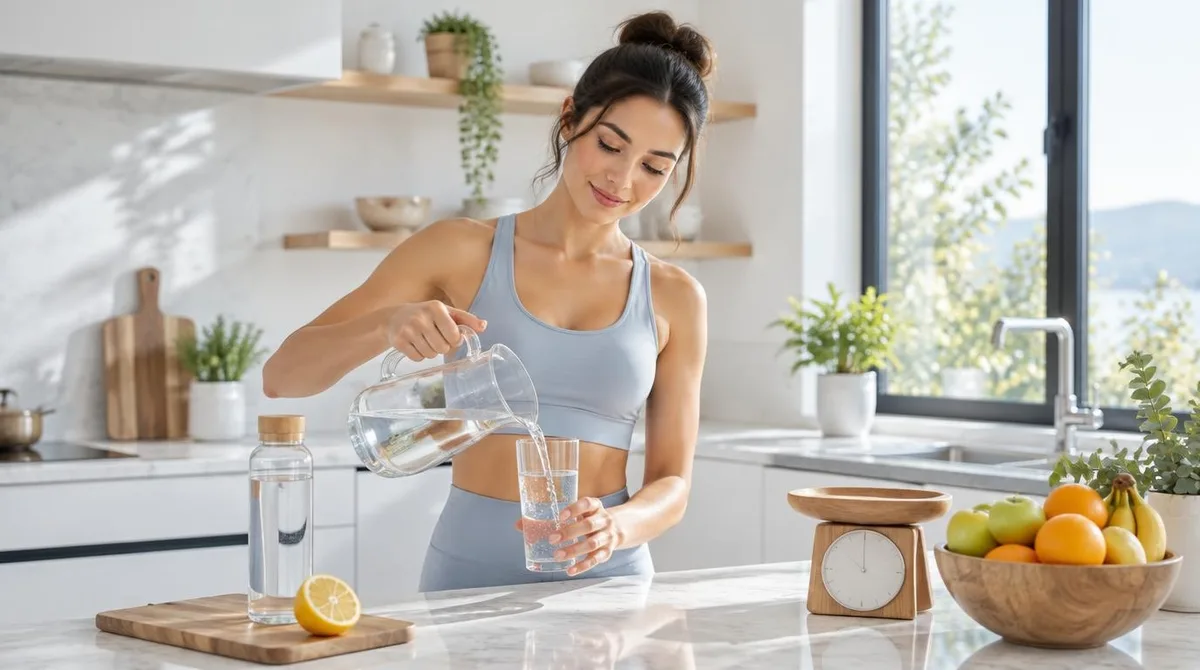
- Keep water visible. A bottle on the desk outperforms any reminder app.
- On hot days or heavy training days, drink before you feel parched and check urine color afterward.
- Count food and other beverages as part of your intake, not as cheating on the water quota.
- If you take fluid-restricting medication or have a kidney or heart condition, follow your clinician's specific instructions rather than general advice.
Consistency beats optimization here, as it does in most of nutrition. A modest, steady intake matched to your day will serve you better than chasing a perfect number. For more plain-language coverage of food and drink choices, the site's nutrition section and broader health guides collect the evidence on everyday decisions, and our conditions library explains when symptoms warrant a clinician rather than a water bottle.
What the evidence leaves open
What is established: fluid needs vary widely between people and between days; food and other beverages supply a substantial share of intake; thirst works well for most healthy adults; and pale urine is a reasonable sign of adequate hydration. What remains uncertain: whether there is any long-term health benefit to deliberately drinking beyond what thirst dictates. Research has explored links between extra water intake and everything from kidney stones to weight, but the findings are mixed and study quality varies. Until the evidence firms up, thirst plus simple self-checks remains the most defensible default.